When Hajja Binta introduces herself, she says:
“I come from a community called Marte. I am a displaced person (IDP).”
It sounds like a simple statement of fact, however, the story behind these words is anything but simple. Binta’s is a story of deep loss and a remarkable transformation.
Binta’s life changed forever when insurgents attacked her hometown.
She had just delivered a baby a few days earlier when gunfire broke out during an armed attack in the community.
“They entered our house. One of them pointed a gun at my father and said ‘give us money! Give us money!’ My father told them there was a dowry for my older sister which was paid some days before, that was all we had. He gave them all the money; that is what saved us. It was the scariest experience of my life, I cried throughout. They were going around the community shooting people at sight.”
Fearing for their lives after that encounter, she took her baby of just a few days old in her arms and with her mother, they fled the community. The journey was long and harsh, and tragically, her baby did not survive.
In the months and years that followed, Binta endured more displacement. Each time she tried to settle somewhere, violence followed. Twice more, she became pregnant, and twice more she lost her newborn babies to the severe living conditions that came with constant displacement.
“Everywhere we went was being attacked.”
“When we finally moved to Maiduguri, I was pregnant with my fourth child, then I gave birth to another baby girl, but I was afraid I would lose her just like I lost her siblings. Then she fell ill; I felt helpless, tired and weak; I was not producing enough breast milk so she was not getting enough to eat. That is when I came here (the ALIMA supported Muna clinic). The health workers said she was malnourished. That was my first time hearing of this sickness which made me worry more. She was given therapeutic milk and they also introduced her to peanut paste (Ready-to-Use Therapeutic Food). At first, I didn’t want it because I didn’t understand what it was, but I eventually accepted and fed her with it daily until she recovered.”
“When we first arrived in Maiduguri, I was ashamed to go outside, I had lost confidence because of what happened to me. I feared another attack. But the way my baby and I were welcomed at the clinic changed everything.”

That visit to the ALIMA supported clinic marked a turning point for Binta. Not only did her baby regain strength, but Binta gradually regained her confidence through several sessions with the Mental Health and Psychosocial Support (MHPSS) team. Through interactions with staff and other patients at the clinic, she began to feel more at ease. When ALIMA announced openings for cleaners, Binta applied.
“I told them I was interested in the job,” she says.
That opportunity gave her a new sense of dignity and stability.
“This job has made a very big difference in my life,” she explained with pride. “With the income I earn, I take care of my family, I support the community by referring mothers to the clinic and helping people in need. I even built a house, that is where we now live and welcome other displaced persons until they find a place of their own.”
Today, Binta works at the ALIMA supported facility, helping maintain hygiene standards that keep patients safe. Her eyes light up when she speaks about her work:
“I enjoy my job very much; it is important work and I am part of an organization that is helping the community. I am happy now.”
Beyond her current home, she has also purchased a small piece of land, a symbol of her determination to secure her family’s future.
Binta, now a proud mother of 4, is a powerful example of what it means to survive, rebuild, and thrive; hers is a remarkable journey from displacement, to provider and active contributor to her community.
ALIMA provides support for children’s nutrition, maternal health, mental health, and general medical care for outpatients at the Muna clinic in Maiduguri, Borno state, Nigeria.
ALIMA also provides 24/7 Basic Emergency Obstetric and Newborn Care (BEmONC) services at Muna Clinic designed to ensure around the clock access to life-saving care for mothers and newborns, prevent avoidable maternal and neonatal deaths by providing timely emergency interventions, reduce the risks associated with home deliveries and unassisted births and strengthen healthcare access for vulnerable women and girls living in displacement and crisis settings. The ALIMA supported Muna Clinic is the only one in the Muna community providing 24/7 SRH services.
Activities at the ALIMA supported Muna clinic are made possible with funding from the European Union and the Crisis and Support Centre (CDCS) of the French Ministry for Europe and Foreign Affairs.
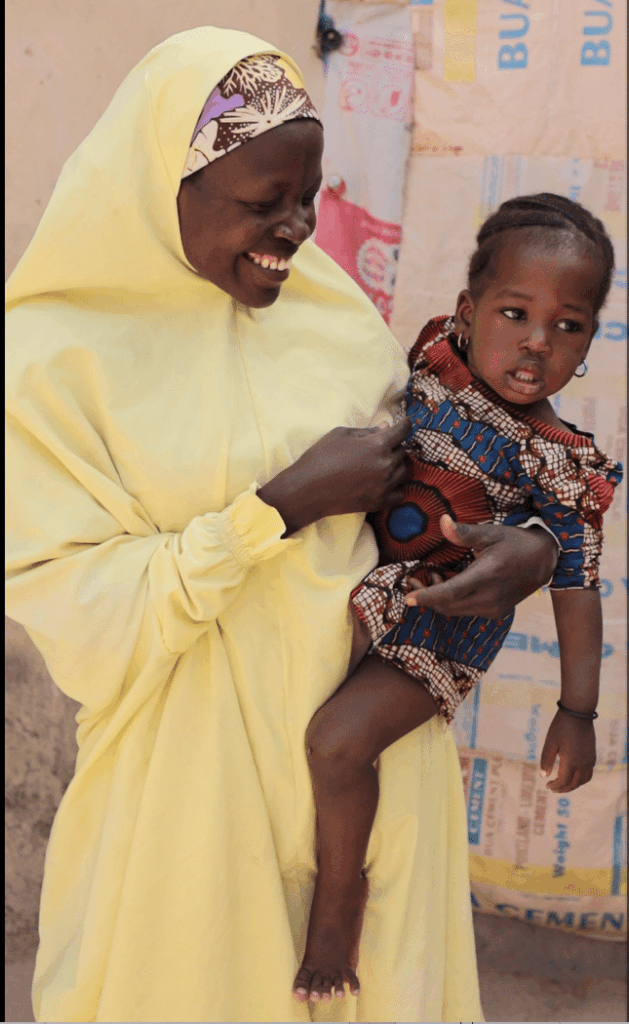
Photo, © Ogun Oluwaseyi / ALIMA