Since 11 August 2026, a cholera epidemic has been affecting the Amma area in Lac Province, Chad. Alongside the Liwa health district, ALIMA and its partner Alerte Santé are treating patients and relying on community relays to slow the disease from spreading, all the way down to the village level.
It was the middle of the night when Nana woke up with a stomachache. The diarrhea began. She waited a little. An hour and a half later, it started again. She realized something was wrong. At first she tried to treat herself, with curdled milk, then with oil. Nothing worked. Someone around her made the call: she had to go to the Amma health center right away. A motorbike taxi was hired for her in the night. When she arrived at the health center, the team examined her and immediately recognized the diagnosis: cholera. Five days later, Nana was cured.
11 August: the first cases
The cholera epidemic began on 11 August 2026 in Amma 3, a village near the Amma health center in the Fouli department, about fifty kilometers from Liwa, the main town of the Liwa health district. Two women presented with diarrhea and vomiting. Within minutes of the alert, more patients arrived. On 16 August, the Kanem provincial health delegation sent a medical team as reinforcement to Lac Province. It arrived in Amma on 17 August.
Overview of the cholera treatment unit set up by ALIMA/Alerte Santé near the Amma health center.
Over the following two weeks, a second outbreak emerged in Foulfoul, a village about ten kilometers from Amma. The epidemic spread. The response set up by ALIMA and Alerte Santé in the very first days of the epidemic absorbed the surge in cases: a cholera treatment unit (CTU) and oral rehydration points (ORPs).
As a reminder, cholera is an acute intestinal infection caused by the bacterium Vibrio cholerae. It is mainly transmitted through the consumption of contaminated water or food, particularly where hygiene and sanitation conditions are inadequate. Its spread is driven by limited access to safe drinking water and a lack of sanitation infrastructure, as well as by conflict, population displacement, and some effects of climate change.
Most infected people do not develop symptoms, but symptomatic cases can cause sudden, profuse watery diarrhea, vomiting, rapid dehydration, muscle cramps, and severe weakness, which are especially concerning in children.
Without prompt treatment, dehydration can lead to death within hours. Prevention relies on access to clean, safe drinking water, regular handwashing, proper wastewater management, community awareness and, in some situations, vaccination.
Since the start of the response, 644 patients have been treated across the entire system. The most serious cases, including moderate and severe dehydration, are treated at the CTU: 163 patients, including 58 severe cases. One patient died on admission.
In the villages, prevention comes first
Dr. Apollinaire WOUYE is the attending physician at the CTU. He was seconded from the Liwa health district to support the response. He works alongside the health district and ALIMA/Alerte Santé, which provide the medicines and medical supplies needed for care.
Dr. Apollinaire WOUYE, attending physician at the CTU, assigned by the provincial health delegation to support the cholera epidemic response.
For him, there is no doubt about the most effective approach: community awareness.
“Raising awareness of preventive measures is our strength. When it’s done well, you can see the result here: we don’t have many patients.”
To break the chain of transmission, awareness-raising plays a key role: it drives behavior change, which significantly reduces new admissions.
ALIMA/Alerte Santé community relays travel from village to village. They inform families and spray the areas around standing water, such as backwaters.Each week, an average of 1,694 people were educated on preventive measures, modes of transmission, warning signs, and what to do if symptoms appear. It is this dual presence that has made it possible to bring the epidemic under control in the area.
Treatment comes next, with one absolute rule: speed. A patient who arrives in a state of shock must not wait. This protocol, applied without delay, explains the results after two weeks: seventy-two patients treated, no deaths.
Four weeks after the start of the epidemic, a vaccination campaign was launched by the Ministry of Health. The campaign vaccinated a total of 101,104 people.
A community relay preparing solutions for routine spraying of the entire Cholera Treatment Unit site established by ALIMA/Alerte Santé.
Nana, then her daughters
Nana has six children. When she arrived in Amma, she did not yet know that five of them would soon join her.
On the third day of her stay, her four daughters fell ill while working in the fields. They were brought to the center, where the team treated them in turn: IV fluids, rehydration, medication.
“By the fifth day, I was cured. And since they’re my children, I became their caregiver.”
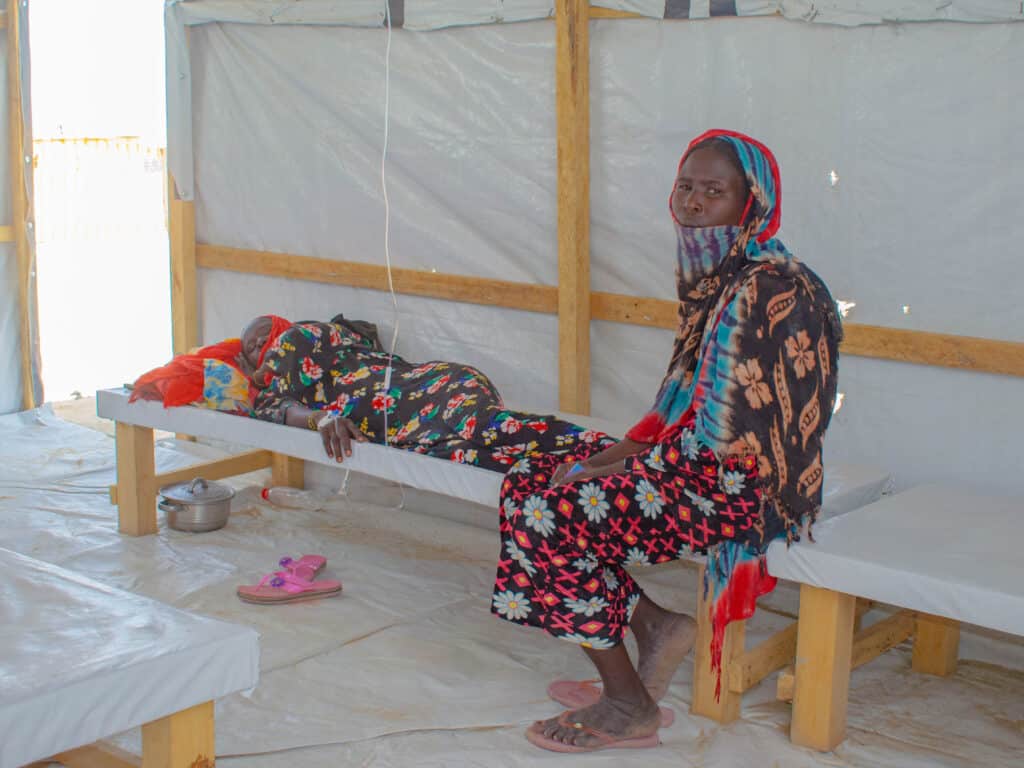
Nana BOTOYE, Bana BOTOYE’s mother, at her daughter’s bedside on one of the beds in the Amma Cholera Treatment Unit established by ALIMA/Alerte Santé.
Two of her daughters recovered quickly and went home to the village. The other two developed a high fever. Additional treatment was prescribed, and within two days the fever was gone. Then a fifth daughter fell ill, and Nana became a caregiver once again.
The whole family has now recovered and gone home. Before leaving, the team gave them clear instructions: wash all clothing and bedding with water, soap, and bleach.
Still too few community relays
The epidemic is receding, but challenges remain. Community relays played a key role in quickly slowing the spread of the disease. Yet there are still too few of them. Strengthening this network, in addition to patient care and vaccination, would help better contain the epidemic.
For Dr. WOUYE, they do most of the work; the center’s team plays a supporting role.
Ce sont eux, dit-il, qui font la grande partie du travail. L’équipe du centre les complète.
“If we could recruit more of them, their work would reach villages that are still out of reach, and patients there would get to the center in time.” says Dr Apollinaire Wouye.
1,230 patients in 7 weeks, one death. The results come down to three things: community relays who spread the information, and the teams’ proactive appro
ach to patient care. The cholera response is made possible thanks to financial support from the European Union (ECHO).