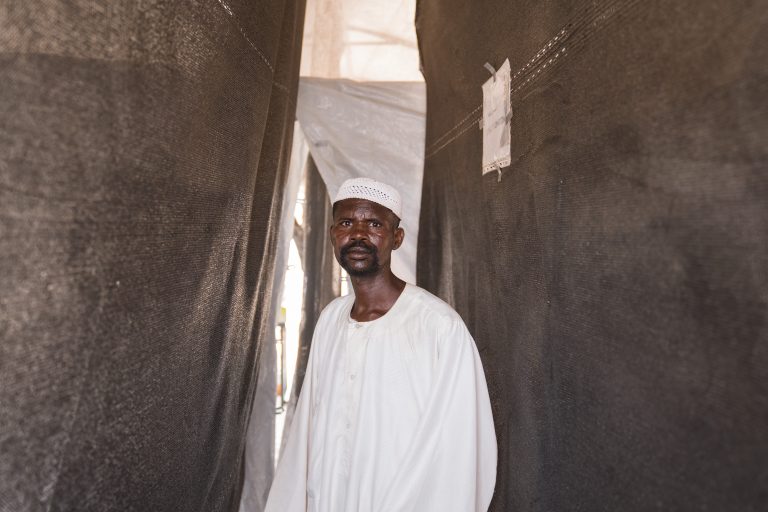
Present in Chad since 2012, ALIMA works in partnership with the Chadian NGO Alerte Santé. In Liwa, a sub-prefecture of the Lake Chad region, our teams provide health services to displaced communities. Free medical consultations are provided for both children and adults. Women benefit from prenatal consultations and their deliveries are assisted by qualified medical personnel.
Discover the stories and the journeys of the people that our teams care for.
MANIE’S STORY
“I am 30 years old. I am a widow. My husband was killed in Boma near the border with Nigeria. It was in 2020…”

“Since my husband died, I left the village where we lived, I gave up all our possessions, our land, to return to live with my parents in Digou with my 5 children.
I have been here since yesterday because Mata Madou, my last child, is sick. He has been losing weight for a few days. Yesterday, ALIMA was in our village, and I explained my problem to the medical team. They decided to send me here to Liwa. An ALIMA vehicle transported us from Digou to Liwa. As soon as we arrived, we were taken care of, and then I was admitted to this ward with my child.”

“The ward we are in is called the Intensive Therapeutic Feeding Center (ITFC). Here my child receives milk every 3 hours. Since my arrival I have not spent a single cent. I am grateful because I cannot afford to feed my children, let alone pay for the motorcycle ride from Digou to here. This is my first time here in Liwa. I don’t know how long we will stay here but my only wish is for my child to get well. ALIMA has promised to take us back to Digou when this is over. Then I can be reunited with my other children and my parents,” says Manie Kablou

BABA’S STORY
“I’ve been married for 13 years and I’m a mother of three.”

“I was born in Médirom, that’s where I grew up, got married and where I live with my husband, my little sister and our three children. There are six of us at home. My little sister helps me regularly with the housework and looking after the children. On the days my little sister goes to school, I stay at home with the children.
This morning I went to the ALIMA mobile clinic with my twins because they have been sick. It has been two weeks already.I don’t like to be idle. I have a small field where I cultivate okra but I have not been there for more than 2 weeks because I had to take care of the twins during their illness. My little sister Yande Kanaye could not do it, she is only 11 years old. Currently, my husband is not at home, he regularly goes to the islands to find work and earn some money.”

“The doctors met with us this morning. They said the twins need to eat a lot more, but it’s not possible because I don’t have enough food to feed my family every day. This morning I received packets of Plumpy’Nut (nutritional food). I will give them to the twins for the next few weeks (I will also have to wash my hands and give them something to drink before feeding them ). Also, one of the twins is epileptic… He has seizures regularly.
This mobile clinic helps us a lot. The team of doctors listens to us and everyone is taken care of. All the care is free, I never paid when I came here.
This morning before I went to the mobile clinic with the twins, I made some food and then gave my third child to my little sister Yande to look after. Later on, I will go to get water while my little sister Yande will stay with the children at home. Yande goes to the Koranic school on school days, but she would like to go to the western school. This is not possible because there is no such school on the Médirom site,” says Baba Moussa.
KANDE’S STORY
“I am 58 years old. I am married and have 10 children. We used to live in Farguemi with my husband and our children, but we had to flee that village because of the (non-state) armed groups.”

“I was born in Kolgouma. I grew up there, but after my marriage, I moved to Farguemi with my husband. We have been living here in Fendé for 6 years now.
Here in Fendé we don’t have much left and I had to take in some of my grandchildren. They are now living with us. We are safe but we have lost everything.
The community workers regularly come to our homes to educate us on many things such as the importance of washing our hands after using the toilet. I have young grandchildren…I have to wash my hands before feeding them. There are certain foods that are good for pregnant women too. We’ve already had counseling and medication. What is incredible is that all this was free of charge,” says Kandé Borom.
ASSIDA’S STORY
“I came to the Amma health center because my daughter Falmata Mbokoye, aged 1, has been sick for 3 days. She has diarrhea.”

“I am 26 years old. I am married and I have 3 children. I am originally from Bohoma. I was born and raised there, but now I live in Amma. We have been in Amma for two years. We are part of the second wave of IDPs who arrived in Amma
Before, in Bohoma, I used to cultivate millet fields, but here I have no land. It is impossible to cultivate. Sometimes I go to help the women of Amma in their fields.
When we arrived, the community health agents told us about the ALIMA/Alerte Santé health center where everyone is provided care for free.
This is not the first time that I have come to this health center. Each time the doctors take good care of us and I have never paid for any care or medication. The doctors said that my child was not eating enough and that he is malnourished.”

“Earlier I received packets of Plumpy’Nut (nutritional food) to give to my child, and medicine for a week. I have to give him two a day, one in the morning and one in the evening. My daughter should also drink water. The problem is that the water we drink and give to the children is not good. Falmata often has diarrhea and loses weight.
I really want the situation in our village to improve, because living here is very difficult. If everything gets better, then I will go back to live in my village Bohoma” says Assida Maroukare.
KANAYE’S STORY
“I am originally from Bohoma. I am a father of 20 children. In my former life, I was a fisherman and a farmer. In Bohoma we lived well, I did not lack anything…”

“The first attack in our village was seven years ago. Members of an armed group came to our village and attacked us. We fled, only to return a few days later.
Some people decided to leave the village, but I decided to stay, despite the insecurity. Life was no longer the same, and we started to be attacked regularly, despite the presence of a military camp near the village. Over a period of seven years, more than 60 people from my community were killed. Among them, uncles, brothers, cousins, aunts. Two years ago, the military camp near our village was attacked, and then our village was attacked and 20 people were seriously injured and 5 people died from their injuries. It was after this attack that I decided to leave the village, to get my family to safety. The village was almost deserted.
My family and I have been living here for two years. We are part of the second wave of IDPs who arrived at the Amma site. We live in safety here in Amma, but we have nothing. To feed my family, I depend entirely on donations from NGOs. I have nothing, I gave up everything when I left Bohoma. Before I was a fisherman and a farmer…
It would be hard to fish here, but I’d like to start farming again. For that, I need some money.
Everyone knows ALIMA here, thanks to the work of the community health agents. My family often comes here for consultations and treatment. Many of us live here on the site. If we could expand the site, I think it would be a very good thing,” says Kanaye Mboh, a displaced person living on the Amma site.
KALY’S STORY
“I am married and I am the mother of 7 children. I am originally from Mamérom, but we have been living here in the Fendé refugee camp for seven years now. We had to flee Mamérom because we were no longer safe there.”

“The community health agents came to me to tell me about the existence of this program. I don’t have the means to pay for my children’s care, so we call on the community agents when there is a problem.
I also have children who are still very small, so I often measure their arms with the MUAC for Mothers bracelets given by ALIMA. This way I can tell if my child is malnourished,” says Kaly Abdou.

“We had to start all over again here in Fendé. Every day we have to fight to find something to eat for the children.”
BAMBY’S STORY
“I am 40 years old, married with 7 children. It has been 7 years since we left our former village, Madiguerom, to come and settle here in Fendé.”

“We used to live in a community over there, some of my brothers and sisters lived with us, as well as my parents. Unfortunately, we can no longer stay there because of the dangerous men of the (non-state) armed groups. So we decided to flee. My husband and I had fields to grow millet, okra etc., but life is very complicated her.
The community health agents come regularly to talk and advise us on health issues. I have used their services to treat my children. Thanks to their advice and teachings, I am able to identify the weight loss of my children with the MUAC for Mothers tri-colored bracelet. It allows me to see if my children are malnourished. If so, I can take them for treatment. Last Tuesday, my daughter and I received medication and we are still undergoing treatment,” says Bamby Tchari.
ACHTA HAWA’S STORY
“I am 22 years old, married and a mother of 2 children. I arrived here at the intensive care unit of Liwa District Hospital 4 days ago, thanks to ALIMA. I was admitted to this ward because I gave birth at home, and my child was born prematurely, at 7 months.”

“I am from Digou. I had several consultations during the pregnancy but childbirth happened before the term. I didn’t think I would give birth so early, especially not at home, but it happened and now I can’t change anything. Here, the doctors take good care of the child and I have been fed since I arrived. My husband is a farmer, he stayed with our other child,” says Achta Hawa Mahamat.

Footnotes
This project has received financial support from the European Union (ECHO) and the American people (USAID). Copyrights for the photographs: © Daniel Beloumou / ALIMA