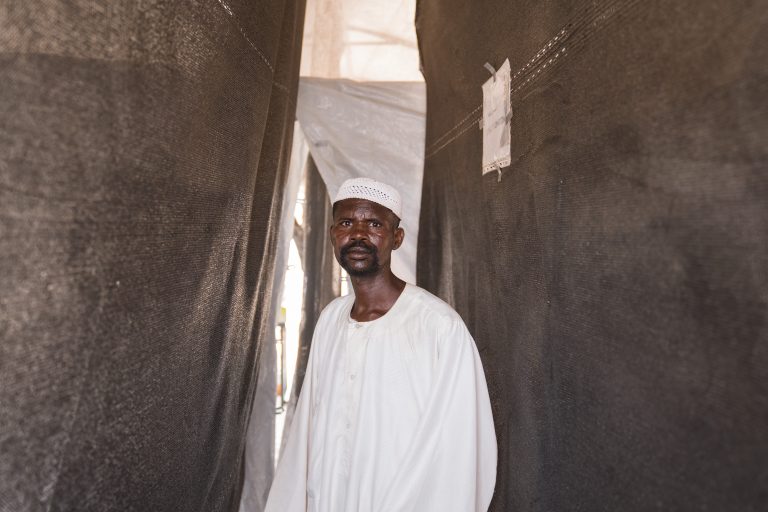
The Haut-Mbomou region in the southeast of the Central African Republic is facing chronic insecurity, and local communities suffer from a lack of access to healthcare.
Many women in the Central African Republic will die while giving life. For every 100,000 live births, 829 women die*. The country has the fifth highest maternal mortality rate in the world.

In the Haut-Mbomou region east of the country, some 1,000 km from Bangui, the town of Zémio has been a hotbed for insecurity since the 1990s. Looting, robberies, and armed conflicts have led to frequent displacement of populations within the country and towards neighboring Democratic Republic of Congo
In the maternity ward of the Zémio hospital, ALIMA teams support pregnant women and their babies throughout pregnancy, from prenatal consultations to delivery, and in postnatal care.
“I don’t have a disease, I was born small.”
Tatiana

Tatiana, 35, has been in the care of ALIMA teams for almost two months. The young woman has just given birth to her second son, little Nathan Dieu Sauvé. Only one meter tall, Tatiana is aware that every pregnancy represents a risk to her life
“It was explained to me that I could only ever give birth by cesarean section.”
Tatiana

“This is the second boy I’ve had, and each time I’ve had to have a C-section. My pelvis is too small, so I can’t give birth vaginally,” she recounts. As with her first child, she came to give birth at the hospital in Zémio, a long way from her home. The health center in Djemah, where she is from, is not equipped to care for her. But the 135 km of bad road separating her town from Zémio makes medical follow-up extremely difficult.
“I came to Zémio hospital on a motorcycle. I was with my little sister, and I was 7 months pregnant.”
Tatiana
Before giving birth, Tatiana spent a month and a half in the Zémio hospital. Today, she and her little boy are doing well.
A HIGH-RISK PREGNANCY AND BIRTH
“My first pregnancy was very difficult, I was in a lot of pain. That wasn’t the case this time, and I’m doing fine. My baby and I are in good health,”
Tatiana

However, Tatiana doesn’t want to take any more risks. “I don’t want to have any more children,” she says. “My family, my partner and I have written a letter to the hospital staff asking them not to let me get pregnant again. It’s for my own health. I have to have operations to give birth. Because I live a long way from the Zémio hospital, it’s too risky.“


Noëlla Ngang-Ndounga, midwife at the Zémio hospital, comes to see Tatiana Anibougbe to check on the healing of her abdomen after her cesarean section. © Cora Portais / ALIMA
“If I get pregnant again and I’m not followed up or referred, if ALIMA is no longer there, I risk losing my life.”
Tatiana

Noëlla, the only midwife in the maternity ward at the Zémio hospital, explains: “Because she’s so small, she can’t give birth without a Cesarean section. Her pregnancies and deliveries are extremely risky, both for her and for the babies. Following the letter sent by Tatiana and her family, and with the support of her partner, we performed a tubal ligation. She will no longer be able to have children.“


Noëlla Ngang-Ndounga, a midwife, in the maternity ward at Zémio Hospital. © Cora Portais / ALIMA
“Without good care, Tatiana and her son would not have survived.”
Noëlla

LAURENTINE, THERE FOR HER BIG SISTER
In the hospital courtyard, Laurentine, Tatiana’s little sister, prepares breakfast and lunch. The food for these meals is distributed free of charge to the women in care and their families
Tatiana didn’t come to Zémio alone. Her partner had to stay in the village to work and continue supporting the family, but her younger sister insisted on joining her.

“We left Djemah by motorcycle. It was a long way to get to the hospital in Zémio,” recalls Laurentine. The 19-year-old student was the only member of the family who could leave the village and miss a few weeks of school. “I had to be there for my sister, to support her. I missed school to be with her, but I don’t regret it. I had to be there. I was very worried, I didn’t know how it was going to work out.”

“I trust the teams here. They took good care of my sister.”
Noëlla

“I’m relieved that I could be with my sister. I feel a lot of joy, and I thank this hospital. We’ll soon be able to go back to Djemah. My sister and her child are alive and well. They were saved and the family is happy. It’s priceless and we are grateful.”

EMILE WITH TATIANA AND HIS SON
Tatiana’s partner, Emile, 32, is a farmer in Djemah. When he learned that his son had been born, he found a way to come and support his partner. His son was already a week old when they met for the first time.
“My partner couldn’t come before. He was able to leave work a week after the C-section. He’s been in hospital with us for almost three weeks now, and we’ll be going back to Djemah together.”
Tatiana


Emile Bohoto, Tatiata Anibougbe’s partner, at the Zémio hospital maternity ward. © Cora Portais / ALIMA
Emile regrets he couldn’t come earlier. “I work a lot in the fields in Djemah,” he says. “Yves Jacob, Tatiana’s first son, was with me at Tatiana’s house. I left him with his grandparents to come and support my partner and meet my son.” Emile knew Tatiana would fight. “I find Tatiana both calm and strong,” he says. Originally from the same neighborhood, they’ve known each other since they were very young. They were both married, had children from their first marriage, and eventually found each other again. “I’ve known her for a long time and watched her grow up. Tatiana is spontaneous. She’s generous and likes to help the community. To me, these are great qualities.”

“It’s a great joy for me to have a little boy, and I’m relieved that Tatiana and our baby are healthy. I was afraid of losing them both.”
Emile

THE RETURN TO DJEMAH
After staying in hospital for almost 2 months, Tatiana can’t wait to get home to her other son, her habits and her house in Djemah. But bringing the whole family home by motorcycle is out of the question
“Medically, they’re ready to leave the hospital. The little boy and his mother are doing well, and the C-section scar is clean,” explains midwife Noëlla. “They will be returning home with an ALIMA car, as making the journey by motorcycle would be too dangerous for mother and child.”

“The road from Zémio to Djemah is tough. Between the potholes, the stones, the dust and the heat [nearly 40°C or 104°F], we cannot let them go home on a motorcycle.”
Noëlla, midwife.

“Seeing Tatiana healthy, smiling and eager to go home, that’s all the satisfaction I get from my job.”
Noëlla, midwife.
Since writing this story, we’ve asked Noëlla for news about the whole family. Tatiana is back home with her baby, her partner, and her little sister, and Yves Jacob has met his little brother
Several months later, the midwife’s voice conveys the emotion of someone for whom other people’s happiness is their own:
“The whole family is doing well. I have an amazing job.”
Noëlla, midwife.

Source: Humanitarian Needs Overview 2023, United Nations Office for the Coordination of Humanitarian Affairs, January 2023.
Footnotes
ALIMA has been working in the Central African Republic since 2013, focusing on providing primary and secondary health care to pregnant and breastfeeding women and children. ALIMA teams also consult and offer medical and nutritional care diagnoses. In Zémio, ALIMA (The Alliance for International Medical Action) has rehabilitated the hospital and provides free care to patients, particularly the most vulnerable populations such as pregnant and breastfeeding women in the maternity ward, children in the pediatric ward, victims of sexual violence, and those impacted by emergencies. The ALIMA teams on site also train health personnel and work in close collaboration with the local health authorities. The aim of this project is to reduce mortality and morbidity by strengthening the capacities of the Haut-Mbomou health district and by improving the supply of and access to health care for the population.Central African Republic, February 2023. This project received financial support from the Fonds Bêkou. Photographs: Cora Portais / ALIMA