

The situation regarding the coronavirus in Africa remains particularly worrying. Many countries on the continent still don’t have enough testing capacity to diagnose patients, or enough trained healthcare workers, protective equipment or medical supplies, including life-saving respiratory machines, to treat patients. Some countries are at risk of facing a ‘double health’ crisis, with COVID-19 amplifying already-high mortality rates related to malaria, malnutrition, diarrheal diseases and respiratory infections.
To fight against the mortality related to COVID-19, ALIMA has been working to support the Ministries of Health in our countries of intervention.
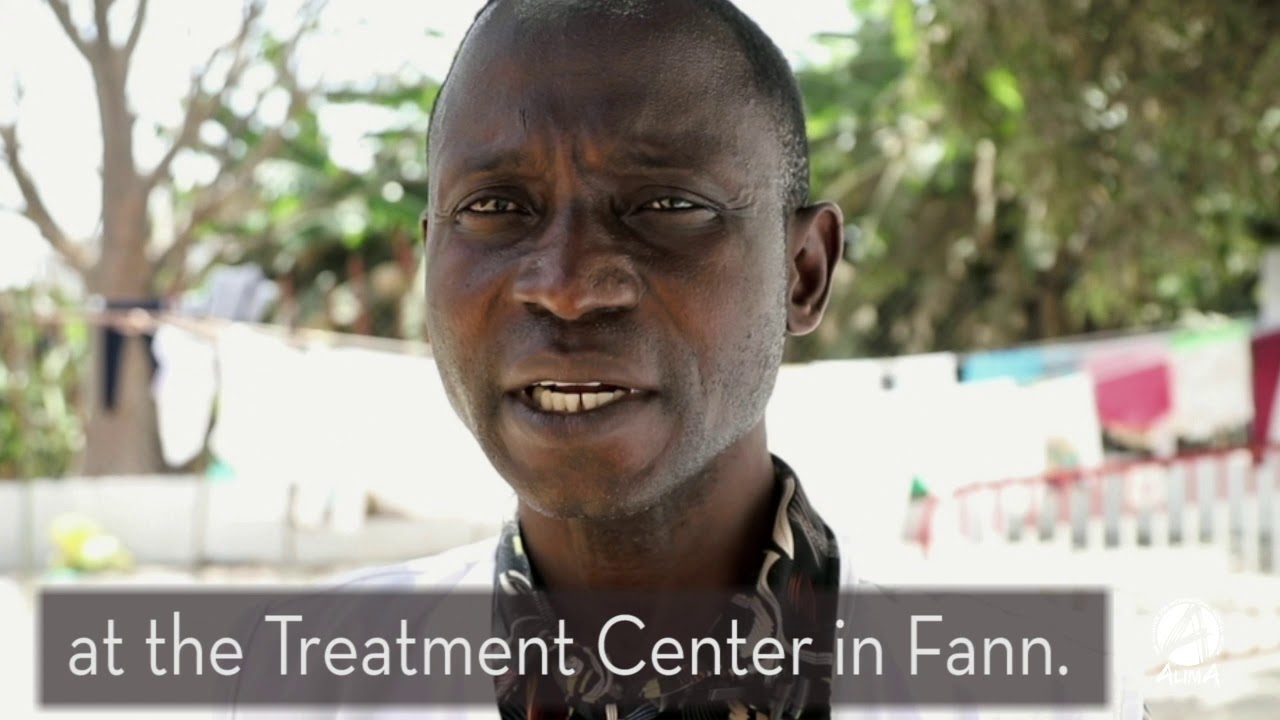
Read on to discover in images ALIMA’s emergency response within the COVID-19 Treatment Center in Dakar, Senegal, at the Fann University Hospital.
MEET DR. MODET CAMARA

Originally from Guinea, Dr. Modet is currently on mission in Senegal, where he is working as ALIMA’s medical team leader in Dakar for the COVID-19 response.
His current role in the crisis: supporting the Senegalese Ministry of health and hospital teams in the care and treatment of infected patients, as well as the setting up of a triage unit for the early detection and isolation of suspected cases, and the organization of Infection Prevention and Control activities. Each morning, Dr. Modet wakes early to prepare to leave for the Fann hospital.


At the entrance of the Fann University Hospital in Dakar, the temperature of visitors and staff are checked and each person must wash their hands with a special chlorinated water before entering the hospital.


Upon arriving at the hospital, Dr. Modet meets with health staff.


AN ALARMING SITUATION
SARS-COV-2 is an infectious virus that is spread from person-to-person via respiratory droplets, and can attack the lungs and other vital organs. No vaccine or treatment is available.
Coronavirus spreads most easily in crowded places where hygiene and sanitation conditions are poor.
“African health systems are very fragile and not ready to face this pandemic. The situation is quite alarming.”
Dr. Papys Lame, Medical Manager for ALIMA’s Emergency Response service
According to the Senegalese Ministry of Health: 5,173 cases have been reported in the country, as of June 15, 2020. Among these cases, 3,424 patients have been declared cured in Senegal and 64 people have lost their lives.
LIFESAVING NEEDS
The ongoing challenge is to supply as much medical and personal protective equipment as possible, and to find the human, medical and logistical resources to help manage the flow of patients.

As the COVID-19 pandemic spread, borders were closed and several governments imposed export restrictions on certain essential materials and personal protective equipment. Some supplies could be obtained locally, but not to the extent necessary, and countries, particularly European ones, which are the regular sources of supply for our projects, could no longer ship relief equipment. Doctors, nurses and other staff could not move from one region or country to another to help the areas most in need.
“We had to adapt very quickly and find new solutions to guarantee the safety of our teams in the field and the care of our patients.”
Oumy Mbaye, ALIMA’s Supply Manager
As the COVID-19 pandemic spread, borders were closed and several governments imposed export restrictions on certain essential materials and personal protective equipment.
Some supplies could be obtained locally, but not to the extent necessary, and countries, particularly European ones, which are the regular sources of supply for our projects, could no longer ship relief equipment. Doctors, nurses and other staff could not move from one region or country to another to help the areas most in need.
One of the most critical needs: Oxygen.
Thanks to the “Oxygen for Africa Campaign” and other support, 18 oxygen concentrators and other respiratory equipment have been delivered to Fann Hospital.

COVID-19 in Senegal: ALIMA supports health workers
PROTECTING STAFF
Before entering the treatment ward and beginning consultations, all staff must put on Personal Protective Equipment. This includes a mask, gloves, boots, goggles and full medical smock.


Preparing to receive infected patients
When a patient is admitted to the Fann University Hospital in Dakar, he/she is directly referred by ambulance to the triage unit of the COVID Treatment Center.
“At the entrance of the COVID unit, the patient is immediately examined and taken care of by medical staff who will then transfer him/her to an individual room, where the medical team at the Treatment Center will be able to provide the necessary care.”
Nicolas Mouly, ALIMA’s Program Manager for Emergency Response


After completing their rounds, Dr. Modet and the other staff must carefully remove and disinfect their protective gear, upon exiting the treatment ward.


ANNA’s STORY
When Anna*, a 24-year-old student from Dakar, began to suffer from a headache, cough and body aches, she went to see her doctor. She was immediately referred to the emergency room, where she was tested for COVID-19.
The next day, Anna’s test came back positive and she was transferred by ambulance to the treatment center at the hospital in Fann.
“I was very scared..I cried every day..I had difficulty breathing, but fortunately I didn’t need supplemental oxygen…Luckily the doctors were there, they reassured me daily: “You are going to get better!”

Five days after being admitted to the hospital her condition began to improve. Soon after Anna tested negative for COVID-19 was discharged. “I was so happy!,” she said, upon receiving the news she could go home.
Anna is one of more than 3,424 patients who have survived coronavirus thanks to the care received at the Fann Hospital.
For Dr. Modet, seeing a patient discharged, healthy again, is his greatest joy:
“We are here to save people’s lives and we can’t do it without the necessary equipment. As a medical practitioner, I feel happy when the patients who need my help get back on their feet and free of this virus.”
Anna*
Footnotes
Cover photo by John Wessels / ALIMA – *Name has been changed to protect the identity of the patient.
This project is made possible thanks to generous funding, notably from AFD (French Development Agency/Agence française de développement) , Unitaid and the Fondation Sanofi Espoir.


