In the south of Ethiopia, children suffering from malnutrition tend to live several hours’ walk from the healthcare they need. ALIMA brings care closer to these pastoralist communities, whose way of life has been upended by a changing climate.
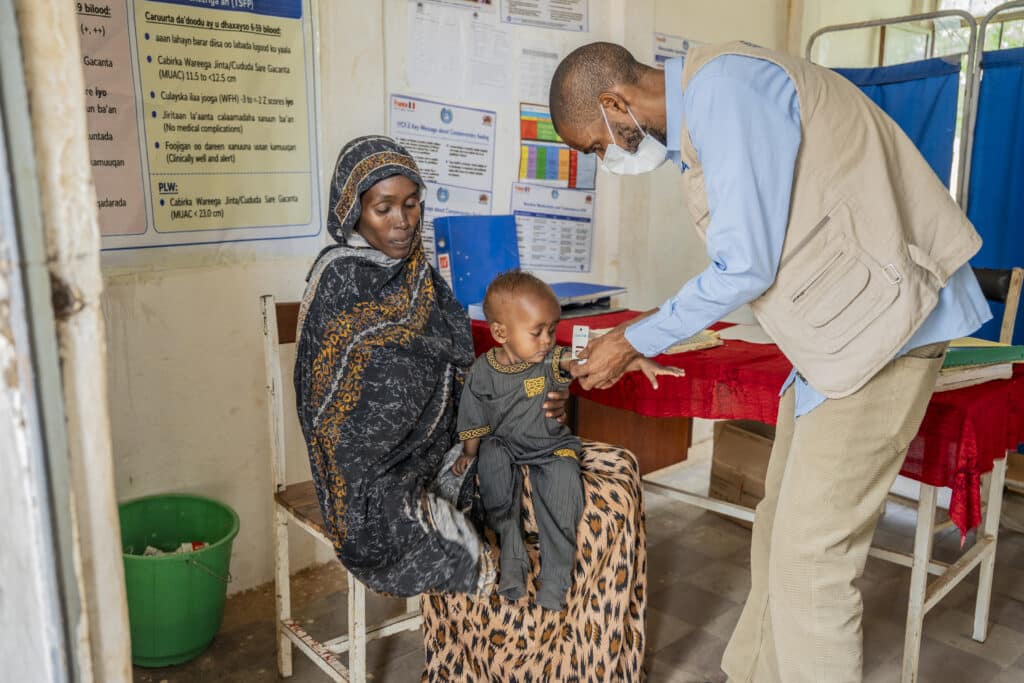
Abdiaziz, ALIMA Nurse Supervisor, screens a malnourished child at the mobile clinic in Yo’o village, 18 km from the nearest hospital. In Hargelle hospital, Anas, ALIMA Mental Health Supervisor, provides psychological support for families and Dr. Shukri, with the Somali Regional Health Bureau, watches over the most serious cases of malnutrition. Abdiaziz, Anas and Dr. Shukri together bring care closer to communities in Afder.
A traditional way of life in Ethiopia faces a new climate reality
In Afder, in the far south of Ethiopia’s Somali region, families have traditionally relied on herding for their livelihoods. A healthy herd means income, milk, and survival. It depends on one simple rhythm: rains coming when they should. Climate change has broken that rhythm. Now the seasons swing from drought that drags on, to sudden floods, and the dry season keeps getting longer.
Herders are having to walk increasingly farther to find water and grazing land, while some have no choice but to settle in towns or displacement sites. Without milk or income, hunger sets in, and children under five are the first to suffer.
Weakened, they have little resistance to measles or malaria. Illness deepens malnutrition, malnutrition opens the door to infection, a cycle that becomes very hard to break.
A few kilometers, a lifeline for malnourished children in Ethiopia
When families need to reach a health center, the effects of harsh conditions often stand in their way. Distances that look short become difficult to cross under an extreme climate.
Abdiaziz, a nutrition nurse with ALIMA, leads the mobile clinic team. Village by village, he screens and treats malnourished children. In Yo’o, 18 kilometers from the nearest hospital, the mobile clinic has been running for several weeks.
“In Yo’o, malnutrition runs higher than elsewhere. We work with Ministry of Health workers, and we support them in measuring, screening, and delivering care. Finding long term solutions to ensure access to care for hard to reach communities remains difficult. No other NGO works here. There is only ALIMA.” Abdiaziz explains.
The clinic brings care to children with acute malnutrition through a full pathway. The teams weigh the child, measure the upper arm with a MUAC band to track how the malnutrition is progressing, counsel mothers, hand out ready-to-use therapeutic food (RUTF), then vaccinate.
“My baby was malnourished, and ALIMA treated her. I was so worried about my child. Today I am relieved. She is out of danger. Without ALIMA, I would have to go all the way to Hargelle hospital, and that is too far from my home.”
Ubah lives in Yo’o with her two children, aged 3 years and 10 months. She has just had the youngest vaccinated, the same little girl treated a few weeks earlier for malnutrition at this very clinic.
The Elkare health center sits in the mountains, more than 100 kilometers from Hargelle hospital. With ALIMA’s support, it keeps lifesaving care within reach for many families. Fadumo holds her 9-month-old baby Shabcaan during his check-up. She walked an hour from home.
“I received mental health support to ease my distress. They knew how to recognize the signs, and they helped me. My child was very sick when I brought him in. Today he is doing well. I am so glad to have this care close to home.”
ALIMA and Ethiopia’s Ministry of Health caring together
ALIMA has worked in Ethiopia since 2023, and today the hands delivering care are entirely Ethiopian, working alongside local health workers like Dr. Shukri, at Hargelle hospital, across five health centers, and through the mobile clinic
“ALIMA advises us on patients’ nutrition and their day-to-day emotional support, and helps us supervise the nurses,” says Dr. Shukri, a general practitioner with the Ministry of Health posted at Hargelle hospital.”
“The hospital was full and we were short of staff. When there was no electricity and the generator ran out of fuel, patients would die for lack of oxygen” Dr. Shukri explains the challenges the hospital faced before ALIMA arrived.
In 2026, ALIMA installed a solar system at Hargelle Hospital and supported fuel for the backup generator to prevent critical energy blackouts.
“We visit the health facilities to see how the nutrition and mental health activities are carried out. Every week, ALIMA and the Ministry of Health caregivers, doctors and nurses alike, sit down together, name the difficulties, and talk through how to work as a team,” says Anas, Mental Health Supervisor for ALIMA.
In Afder, the climate does more than dry out the pastures. It pulls families away from care just when they need it most. Sometimes a few kilometers less between a child and a health center are enough to save a life.
This project was made possible thanks to humanitarian funding from the CIAA IFSAN.
Pour offrir les meilleures expériences, nous utilisons des technologies telles que les cookies pour stocker et/ou accéder aux informations des appareils. Le fait de consentir à ces technologies nous permettra de traiter des données telles que le comportement de navigation ou les ID uniques sur ce site. Le fait de ne pas consentir ou de retirer son consentement peut avoir un effet négatif sur certaines caractéristiques et fonctions.
Fonctionnel
Always active
L’accès ou le stockage technique est strictement nécessaire dans la finalité d’intérêt légitime de permettre l’utilisation d’un service spécifique explicitement demandé par l’abonné ou l’utilisateur, ou dans le seul but d’effectuer la transmission d’une communication sur un réseau de communications électroniques.
Préférences
L’accès ou le stockage technique est nécessaire dans la finalité d’intérêt légitime de stocker des préférences qui ne sont pas demandées par l’abonné ou l’internaute.
Statistiques
Le stockage ou l’accès technique qui est utilisé exclusivement à des fins statistiques.Le stockage ou l’accès technique qui est utilisé exclusivement dans des finalités statistiques anonymes. En l’absence d’une assignation à comparaître, d’une conformité volontaire de la part de votre fournisseur d’accès à internet ou d’enregistrements supplémentaires provenant d’une tierce partie, les informations stockées ou extraites à cette seule fin ne peuvent généralement pas être utilisées pour vous identifier.
Marketing
L’accès ou le stockage technique est nécessaire pour créer des profils d’internautes afin d’envoyer des publicités, ou pour suivre l’utilisateur sur un site web ou sur plusieurs sites web ayant des finalités marketing similaires.