Published in September 2026 in The Lancet Primary Care, the results of a clinical trial conducted in Chad by ALIMA and its partners show that a simple, low-cost tool, the RISQ system, helps health workers identify the most critically ill children in time and shows high probability of reducing mortality.
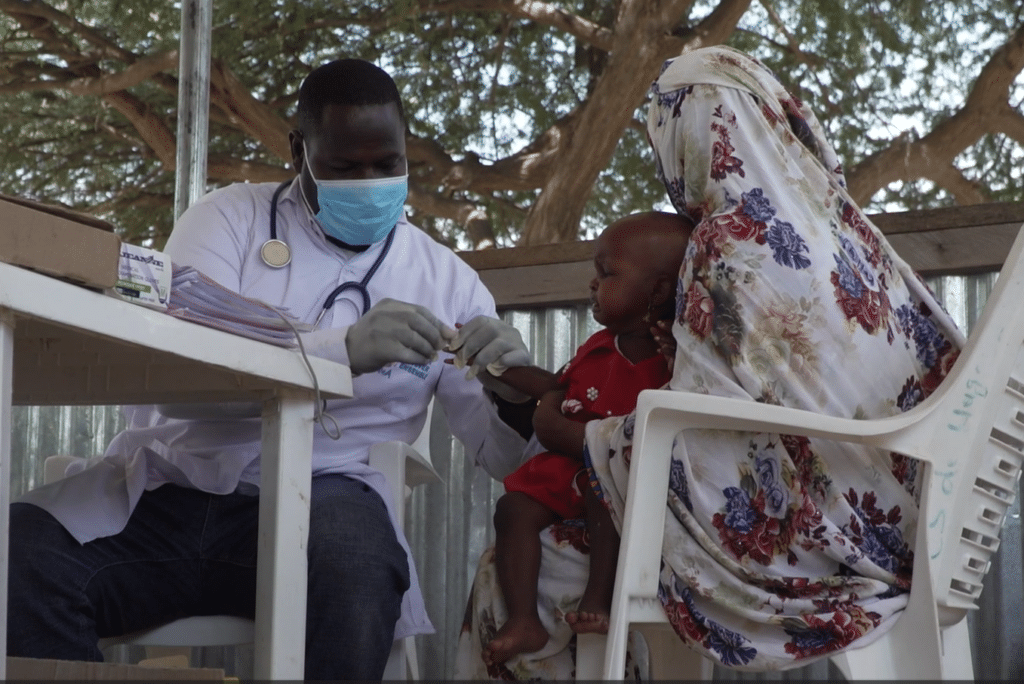
It’s barely 8 a.m., and the health center courtyard is already full. Mothers wait with children in their arms or on their backs. This one has had a fever for three days, this other one hasn’t been able to keep anything down since yesterday, another is coughing and breathing fast. All of them are being treated for acute malnutrition, and all of them are vulnerable.
You’re a nurse. You’ve had one or two years of training, and today, like every day, the same question comes up with each child: “Can this child go home with treatment, or do they need to go to the hospital right now?”
It’s a heavy decision. Referring a child means asking a family to make a long journey and take on costs they can’t always afford. Not referring them means risking that their condition gets worse. And the signs of severe illness aren’t always obvious: a quiet child isn’t necessarily a child who is doing well.
This is the daily reality for thousands of health workers in sub-Saharan Africa, where most outpatient consultations are provided by nurses who lack resources and specialized training. Because they weren’t referred to hospital appropriately or early enough, some children die.
Now imagine that a sheet of paper on your desk guides you. You record measurements of seven items including vitals signs and clinical assessments you already know how to measure: heart rate, respiratory rate, respiratory effort, oxygen saturation, oxygen use, temperature, and level of consciousness.
A sheet of paper, a pulse oximeter, and a thermometer: three easy-to-use tools. In one to two minutes, you get a score. The score doesn’t replace clinical judgment, but it supports it: it quantifies the child’s severity of illness and helps you decide whether they should be transferred to hospital.
That’s the principle behind the RISQ system (Responses to Illness Severity Quantification), developed collaboratively with researchers from the University of Maiduguri Teaching Hospital in Nigeria, and SickKids Research Institute in Canada, and it performs similarly among different underlying conditions: diarrhea with dehydration, malaria, respiratory infection, or other infections.
For health workers, this score changes a lot. They know which children to prioritize, and they can justify a transfer to both the family and the hospital.
A Rigorous Trial in 34 Health Centers
To measure the tool’s real impact, ALIMA, its national partner the NGO Alerte Santé, Chad’s Ministry of Health, and researchers from the SickKids Research Institute (Canada) and University of N’Djamena, conducted a 12-month cluster-randomized clinical trial between 2023 and 2024.
The study took place in 34 health centers in Ngouri district, 230 km (143 miles) from N’Djamena. It followed over 10,000 children aged 6 to 59 months being treated for acute malnutrition.
40% fewer deaths in centers using RISQ: 24 deaths among 7,497 children, compared with 60 deaths among 7,174 children in control-group centers.
85% of health workers found the RISQ system useful in their daily practice.
78% of health workers felt confident using the score sheet after just one day of training.
“RISQ gave health workers in Ngouri something precious: confidence in their own judgement. They measure, they score, and they have something concrete to rely on. I saw health workers who had been hesitant to refer a child do so with confidence, because they knew why.” Dr. Mermoz Difo, ALIMA Deputy Medical Coordinator in Chad during the clinical trial.
An Innovation Born in the Field
RISQ is designed to work where resources are scarce: it relies on clinical measures routinely collected, minimal equipment and short training.
“The RISQ system empowers nurses by providing them with a safety net to support their clinical decision making. RISQ also allows for a common language to be used across the healthcare team, to ensure that prioritization of care is translated upon arrival to hospital.” Nancy Dale, Lead author of the study.
These results are relevant to all NGOs and public health systems providing outpatient care for children with acute malnutrition. Integrated into routine care, RISQ could significantly strengthen the early detection of high risk children.
A digital version of the tool, the RISQ Digital app, is being developed and further evaluation in different contexts is planned for the coming year.