

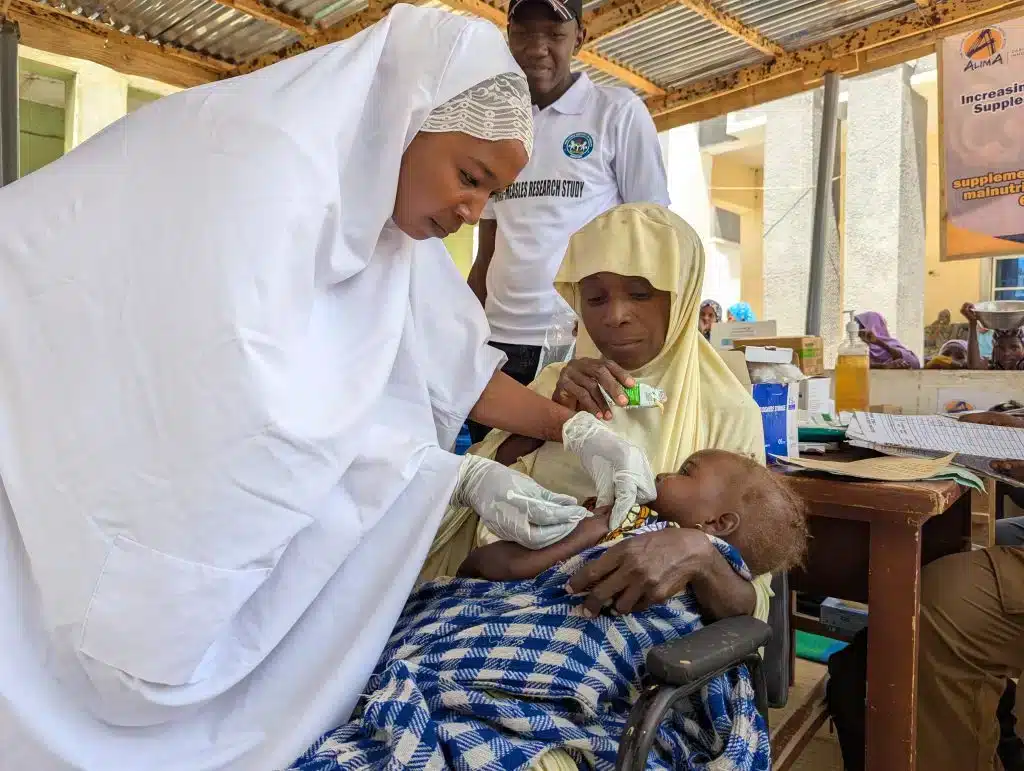
In many parts of Africa, malnutrition is widespread and children are under-vaccinated. These two realities feed a vicious cycle: a malnourished child is less able to fight off infections, and a common illness that is poorly treated (diarrhea, respiratory infection, malaria) can quickly tip into severe acute malnutrition. The risk of death is greatly amplified.
For ALIMA’s teams, who treated more than 350,000 children suffering from acute malnutrition in 2025, this is a daily reality. Many children could have been spared with better immunity. That is the case for Maimouna’s little girl, whose story she shares below.
Testing a strategy that works on two fronts at once
In Yobe State, Nigeria, researchers and humanitarians have just confirmed an idea first put forward about a decade ago: distributing SQ-LNS (a 20 g lipid-based nutrient supplement recommended by the WHO to prevent malnutrition) encourages families to return to the health center, and therefore to have their children vaccinated.
In 2024, ALIMA — in partnership with researchers from Inserm, the IRD, and the University of Bordeaux, from Côte d’Ivoire’s PAC-CI program, and from the university and Ministry of Health of Yobe State — launched a cluster randomized controlled trial.
The principle: to compare health areas where families received routine vaccination alone (control areas) with areas where SQ-LNS was distributed on the same day to children aged 6 to 23 months (NutriVax areas). In one year, nearly 20,000 children received the nutritional supplement.
Clear-cut results
The first striking signal: family engagement. Of the nearly 20,000 children enrolled, there were only 13 dropouts. Despite the distance, the cost of transportation, and the time involved, the mothers came back, month after month.
On vaccinations, the results confirm what teams had observed in the field:
- Children followed in the NutriVax areas were twice as likely to be vaccinated against measles as those in the control areas.
- The number of “zero-dose” children (those who had never received a single vaccine) was cut in half in the NutriVax areas.
For every 100 children, the NutriVax intervention made it possible to vaccinate 20 more children against measles compared with the group not covered by NutriVax. And by reducing the number of “zero-dose” children, NutriVax contributes directly to one of the goals of the WHO’s Immunization Agenda 2030: to halve the number of “zero-dose” children by 2030.
These results have been published in the journal Nature Medicine.
Read the full article here: https://www.nature.com/articles/s41591-026-04675-1
“We now have the scientific proof we had been waiting for: distributing SQ-LNS on vaccination day motivates families to come back. In a state where measles coverage sometimes falls below 30%, this is a decisive step forward for our children and for Yobe’s health system. In fact, after ALIMA shared the trial’s preliminary results, Yobe State added a line to its budget to fund SQ-LNS.”
Prof. Baba Goni, Medical Director of Yobe State University Teaching Hospital and co-principal investigator of NutriVax
A paradigm shift
By integrating malnutrition prevention and vaccination, we create a virtuous cycle that improves child survival.
“What NutriVax demonstrates is that a preventive nutritional intervention can act as a genuine lever for reaching health centers and, as a result, vaccination. A randomized trial of this scale, carried out in such a difficult context, offers a rare level of evidence. It opens a concrete path to keeping up with and catching up on the vaccination schedule and reaching the ‘zero-dose’ children who don’t access health centers and slip through community vaccination campaigns.”
Cécile Cazes, epidemiologist researcher, ALIMA / Bordeaux Population Health
For Kevin Phelan, senior nutrition advisor at ALIMA, the equation is clear:
“It’s a triple benefit: less malnutrition, more vaccinated children, and improved child survival. We call on governments and international donors to invest in SQ-LNS. And we urge policymakers and health workers to consider associating SQ-LNS with routine vaccination in the hardest-hit regions.”
Scaling up in Chad, Niger, and Cameroon
Since May 2025, ALIMA has been running two similar trials in Ngouri, Chad, and Mirriah, Niger. The goal: to demonstrate the strategy’s effectiveness in different high-malnutrition, low-vaccination-coverage settings. Up to 10,000 children will receive SQ-LNS in Chad and 20,000 in Niger.
A new trial will also begin in Cameroon by the end of 2026 to assess the effect of the NutriVax strategy on children’s vaccination coverage against malaria, another major health challenge in sub-Saharan Africa.
The NutriVax trial was conducted as part of the Clinical and Operational Research Alliance (CORAL), which brings together ALIMA and researchers from Inserm/IRD/University of Bordeaux and the PAC-CI program (Abidjan, Côte d’Ivoire), in partnership with the Yobe State Ministry of Health and researchers from Yobe State University, in Nigeria. The results are published in the scientific journal Nature Medicine.
The NutriVax clinical trial in Nigeria was supported by Gavi, the Vaccine Alliance, the Eleanor Crook Foundation (ECF), the ALIMA Foundation, and private donors.


